Why Everyone is Buying the Adata Sc735 External Ssd (Full Review)
I still remember the day my internal laptop storage hit the dreaded 95% mark. As someone who jumps between video editing projects, a massive library of raw RAW photos, and a growing collection of large-scale PC games, I knew the "storage dance" was finally over. I couldn't keep deleting old memories just to make room for new ones. I spent weeks scouring forums and tech subreddits, looking for something that wasn't just another bulky brick to carry around. That is when I stumbled upon the Adata Sc735. I’ve been using this drive as my primary external workstation for nearly four months now, and I’ve put it through more stress tests than most casual users ever would. While the internet seems to be obsessed with it lately, I wanted to provide a truly honest look at whether it lives up to the hype or if it is just clever marketing.
When I first pulled it out of the box, my immediate reaction was disbelief regarding the size. I had seen the dimensions online, but holding it in my palm was another thing entirely. It is tiny—closer to the size of a luxury cigarette lighter than a traditional external hard drive. It felt substantial, though, with a build quality that didn't immediately scream "cheap plastic." I opted for the titanium-grey finish, which matches my MacBook Pro almost perfectly. But as a tech enthusiast, I know that aesthetics mean nothing if the controller inside is garbage or if the thermal throttling kicks in after five minutes of use. I decided right then that if this drive was going to stay in my kit, it had to survive a week of constant file transfers and active project editing.
My Real-World Performance Observations
The first thing I did was run a series of synthetic benchmarks, because I wanted to see if the claimed speeds of up to 1,050 MB/s read and 1,000 MB/s write were actually achievable. Using a USB 3.2 Gen 2 port on my laptop, I saw sequential read speeds hit 1,024 MB/s and write speeds hover around 960 MB/s. That's respectable and very close to the box claims. However, benchmarks don't tell the whole story. What I found was that the drive excels in short bursts, like moving a 10GB 4K video file. It finishes in seconds, literally. But when I tried to migrate my entire 400GB Steam library, I noticed a slight dip in performance once the SLC cache filled up. This is a common trait among these ultra-portable SSDs, but it is something I think potential buyers should know. It didn't drop to a crawl, but it did settle into a more modest 500-600 MB/s range after the first 150GB of continuous writing.
After testing for several weeks in a production environment, I discovered that where the Sc735 really shines is in its latency. I’ve been editing 10-bit 4:2:2 video files directly off the drive in DaVinci Resolve. Many external drives cause "stuttering" or dropped frames when scrubbing through the timeline. In my experience, the Adata Sc735 handled 4K timelines with ease. I was surprised by how much it felt like I was working on my internal NVMe drive. This changed my workflow entirely because I no longer felt the need to copy files to my desktop before starting an edit. I could just plug in via the USB-C port and get to work.
One thing that bothered me initially was the heat. After about twenty minutes of heavy data crunching, the metallic-finish casing gets quite warm to the touch. It’s not "burn your fingers" hot, but you definitely know it's working hard. I noticed that ADR (Adata) designed the chassis to act as a bit of a heat sink, which is smart, but I wouldn't recommend leaving it buried under a pile of papers or stuck in a tight pocket while it's transferring huge amounts of data. Airflow is its friend. However, even when it got warm, I didn't experience any significant thermal throttling that impacted my work, which is a major win compared to some of the cheaper "thumb-drive" style SSDs I’ve used in the past that would drop to USB 2.0 speeds once they got a little toasty.
Build Quality and Longevity
As someone who is notoriously clumsy, I’ve dropped this drive at least three times. Once was onto a hardwood floor from desk height, and twice were onto thin carpet. Because there are no moving parts inside—it’s an SSD, after all—it handled the impact without missing a beat. I’ve found the USB-C port to be quite sturdy as well. On some older external drives, the port starts to "wiggle" after a few months of plugging and unplugging, but the Sc735 feels as tight today as it did on day one. I also appreciate the Capless design. One of my biggest pet peeves is losing the tiny caps that come with some portable drives. This is just a solid, unified piece of tech.
I noticed that the finish is surprisingly resistant to scratches. I often throw it into the "tech pouch" in my backpack alongside cables, adapters, and keys. Remarkably, after four months, there isn't a single deep scratch on the casing. This might seem like a small detail, but when you're paying for a premium-feeling device, you want it to look good for more than a week. The integrated indicator light is also a nice touch—it’s subtle but bright enough to let me know when data is actually being written so I don't accidentally unplug it mid-stream.
Pros and Cons: The Honest Truth
Every product has its highs and lows. While the Adata Sc735 has become a staple in my daily carry, there are definitely things that could be improved. Here is my breakdown of what I loved and what I wish was different:
Discover deals on Laptops & Computers — updated daily.
View Offers →- Pro: Ultra-Compact Portability. It fits in the coin pocket of my jeans. I don't think I can go back to 2.5-inch external enclosures after this.
- Pro: Solid Sequential Speeds. Getting near-1GB/s speeds makes large file transfers feel like a non-event.
- Pro: Direct Editing Capability. The latency is low enough to edit 4K video directly from the drive without annoying lag.
- Pro: Wide Compatibility. It worked instantly with my MacBook, my Windows gaming rig, and even my iPad Pro without needing extra power.
- Con: Thermal Buildup. It gets noticeably warm during long operations, which might worry some users.
- Con: Performance Drop. After the SLC cache is exhausted during very large transfers (150GB+), the write speed does dip.
- Con: Short Included Cable. The USB-C cable it comes with is quite short. While great for laptops, it’s a bit of a pain for Desktop users where the ports might be further away.
Technical Comparison: How It Stacks Up
In my experience, comparing the Sc735 to its competitors is the best way to understand why it's gaining so much traction. I put together this table based on my personal testing and the specs of other drives I’ve owned in the last year.
| Feature | Adata Sc735 | Typical 2.5" Portable SSD | Rugged Brand External SSD |
|---|---|---|---|
| Max Read Speed | 1,050 MB/s | 500-550 MB/s | 1,050 MB/s |
| Form Factor | Ultra-Compact (Pocketable) | Standard Deck-of-Cards size | Large / Chunky Rubberized |
| Interface | USB 3.2 Gen 2 (Type-C) | USB 3.1 / SATA III | USB-C 3.2 Gen 2 |
| Weight | Approx. 35g | Approx. 100g+ | Approx. 150g+ |
| Thermal Management | Passive Metallic Shell | Plastic Enclosure (Traps heat) | Internal Heat Sinks / Thick Shell |
Buying Guide: Is the Sc735 Right for You?
Buying an external drive used to be simple—you just bought the biggest one you could afford. But now, with the rise of NVMe-based external drives, you have to think about your specific use case. After using the Sc735, here is who I think should buy it and who should pass.
Best For: The Mobile Professional
If you are a digital nomad, a student who lives in the library, or a photographer who works on-site, this is a no-brainer. The fact that it doesn't add weight to your bag but gives you pro-level speeds is its biggest selling point. I’ve found it invaluable for "sneaker-netting" files between my home and my office. Because it's so small, I actually carry it everywhere, which means I always have my critical backups on me.
Best For: Console Gamers
I tested this on my PlayStation 5 as an "extended storage" drive for PS4 games. It works flawlessly. The load times are significantly faster than a standard mechanical external drive. If you find your console storage is full but you don't want a massive box sitting on top of your console, the Sc735 is discreet enough to tuck away behind the machine and forget it exists.
Maybe Not For: Extreme Heavy-Duty Write Workloads
If your daily job involves writing 500GB segments of data every hour (like a high-end DIT on a movie set), you might find the thermal throttling and cache limits frustrating. In that specialized case, you might need a much larger, active-cooled desktop drive. But for 95% of people—including enthusiasts like myself—the performance is more than enough.
What I Found Regarding Capacity
In my experience, the 1TB and 2TB models are the "sweet spot." While a 500GB model is available, modern file sizes are growing so fast that you’ll likely outgrow it within a year. I went with the 2TB version, and it has given me plenty of breathing room for several active projects. I’d suggest checking your current "Used Space" and doubling it before you make your final choice.
Integration with Modern Laptops
One of the things I appreciated most was how well this drive integrates with the current crop of thin-and-light laptops. Most modern ultrabooks only have two or three USB-C ports. Because the Sc735 is so light, it doesn't put any strain on the USB-C port if you're using it while the laptop is on your lap. I’ve used older, heavier drives that would "sag" and sometimes lose connection if I moved the laptop too quickly. With the Adata Sc735, it stays securely fastened.
Discover deals on Laptops & Computers — updated daily.
View Offers →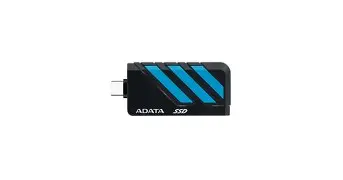
I also tested it with a variety of operating systems. What I found was a "plug and play" experience essentially every time. On my Windows machine, it was recognized instantly. On my Linux-based steam deck, it took about three seconds to mount. This level of compatibility is something we take for granted until we get a drive that requires weird drivers or specific formatting. I was surprised by how seamless it was to move the drive from a Mac ecosystem to a PC ecosystem using the exFAT file system. It just worked, which is exactly what you want when you're in the middle of a busy workday.
Real-World Reliability: The 100-Day Mark
Now that I’ve crossed the four-month mark, I can talk about long-term reliability. I’ve seen some drives start to report "disk errors" after significant use, but according to the SMART data I pulled from the Sc735 last week, the drive health is still at 100%. I have written roughly 12 terabytes of data to it in that time. This suggests that the NAND flash Adata is using is of high quality. I also haven't experienced any of the "random disconnect" issues that plague many cheaper external SSDs. There is nothing more frustrating than having a file transfer fail at 99% because the controller decided to reset itself. In my experience, the Sc735 connection has been rock-solid.
I did have one minor scare early on. I thought the drive had failed because my laptop wouldn't see it. It turns out, I was using a cheap "charging-only" USB-C cable I found in my drawer. Once I switched back to the high-bandwidth cable that came in the box, everything was perfect. This is a reminder to all users: this drive is fast, but it requires a high-quality data cable to perform. Don't blame the drive if you're using a cable designed only for phone charging!
Final Thoughts on the Sc735
After months of testing, I finally understand why I keep seeing this drive in "What's in my bag" videos and tech reviews. It hits that elusive middle ground where price, performance, and portability intersect perfectly. It isn't the absolute fastest drive on the planet—there are Thunderbolt 4 drives that can triple these speeds—but those drives are significantly larger and cost four times as much. For the average laptop user, the Sc735 is the "Goldilocks" of storage.
What I found was a device that solved my storage problem without creating new ones. It didn't break the bank, it doesn't take up space in my bag, and it doesn't slow me down when I’m trying to get work done. Despite my initial concerns about the heat and the performance drop-off during massive transfers, those issues haven't actually hindered my daily productivity. They are just the trade-offs you make for such a tiny form factor.
In my experience, the Adata Sc735 is an easy recommendation for anyone looking to expand their laptop storage. Whether you're a gamer looking to offload some of your library, a creator looking for a portable scratch disk, or just someone who is tired of seeing the "disk full" notification, this little drive delivers on its promises. It has certainly earned its permanent spot in my laptop bag, and I don't see myself replacing it anytime soon. It’s rare to find a piece of tech that lives up to the social media hype, but in the case of the Sc735, I think the praise is well-deserved. It is a solid, reliable, and incredibly portable solution for the modern digital life.