Is the Zettlab D6 Nas Device Still Good in 2026? Long-Term Review
When I first unboxed the Zettlab D6 NAS back in late 2024, the landscape of home networking and personal cloud storage was in a state of rapid transition. We were seeing the first real push toward affordable 10-Gigabit networking for the masses and a shift from traditional spinning platters to all-flash or hybrid storage arrays. I remember sitting at my desk, looking at the sleek, minimalist chassis of the D6, and wondering if this relatively new player in the market could actually compete with the established titans like Synology or QNAP. Now, as we move through 2026, I’ve had more than eighteen months of continuous uptime with this unit. It has lived through firmware updates, power outages, and several shifts in my own creative workflow.
Choosing a Network Attached Storage device is rarely a "set it and forget it" affair for someone like me. I treat my data with a level of paranoia that borders on obsessive. I’m a freelance video editor and a hobbyist photographer, which means my storage needs aren't just about capacity; they are about throughput, reliability, and the ability to access my files from the road without jumping through a dozen VPN hoops. After using the Zettlab D6 as my primary production server for nearly two years, I’ve developed a love-hate relationship with it that only a long-term owner can truly understand. It’s not the perfect machine I thought it was during the honeymoon phase, but it has proven to be an indispensable part of my studio. In this review, I want to break down why this device still holds a spot on my desk in 2026 and where it’s starting to show its age.
Hardware Performance and the 2026 Standard
The core of the Zettlab D6 is built around an Intel Core i5-1335U processor, which felt like overkill for a NAS two years ago. However, in 2026, as we’re seeing more containers and virtual machines demanding higher resources, that processor has aged gracefully. One thing I’ve noticed is that while the CPU has plenty of headroom, the original 16GB of RAM it shipped with became a bottleneck within the first six months. I eventually bumped it up to 64GB of DDR5, and that’s when the D6 really started to sing. If you’re looking at picking one of these up second-hand today, the first thing I’d tell you is to ignore the "stock" configurations and maximize the memory immediately.
What really sold me on the D6 was the hybrid drive layout. It features four standard 3.5-inch SATA bays and two internal M.2 NVMe slots. In my configuration, I’ve been running four 22TB Seagate Exos drives in a RAID 10 array for my bulk archive, with two 4TB NVMe drives acting as a high-speed read/write cache. This setup has been transformative for my 4K video editing workflow. When I’m pulling raw footage over the 10GbE connection, I consistently see speeds hitting the 900MB/s mark. It’s the closest I’ve ever felt to working off a local SSD while technically being connected via a network cable. However, I was disappointed to find that the NVMe slots were limited to PCIe Gen 3 speeds. In 2026, when Gen 5 is becoming common, this feels like a missed opportunity for future-proofing, even if Gen 3 is technically "fast enough" for most network saturated tasks.
The build quality is another area where Zettlab impressed me. The chassis is mostly aluminum, which acts as a giant heatsink. In my experience, even during heavy summer heatwaves when my office AC was struggling, the drive temperatures stayed within a safe 38-42 degree Celsius range. The fans are surprisingly quiet at idle, though I did notice a high-pitched whine developing in the primary 120mm exhaust fan after about a year. I ended up replacing it with a Noctua fan, which was a simple fix, but for a premium-priced unit, I expected the bearings to last a bit longer.
The Software Experience: ZettOS Evolution
When the Zettlab D6 launched, the proprietary operating system, ZettOS, was a bit of a gamble. It promised a "modern, container-first" approach to NAS management. At first, I found the interface a bit too simplified—it felt like it was trying too hard to look like a smartphone OS rather than a professional server environment. However, after several major updates, the 2026 version of ZettOS (v3.4) has matured significantly. The integrated Docker management tool is, in my opinion, the best in the business. I currently run about fifteen containers, including Plex, Home Assistant, a private Git server, and a Pi-hole instance, and the resource overhead is negligible.
One thing that bothered me early on was the lack of a robust mobile app. Back in 2024, the ZettConnect app was prone to crashing and had a terrible habit of failing to sync photos in the background. I nearly gave up on using it as a Google Photos replacement. Fast forward to today, and the software team at Zettlab has clearly put in the work. The remote access feature, which uses a proprietary Relay protocol, is now incredibly stable. I can be at a coffee shop three cities away, open my laptop, and mount my NAS as a local drive with minimal latency. It’s simplified my life significantly, though there is still a nagging concern about being dependent on Zettlab's relay servers. If the company ever goes under, I’d have to set up Tailscale or a manual WireGuard VPN to maintain that ease of use.
Looking for the best Laptops & Computers deals on Amazon?
Shop Amazon →I also have to mention the "SnapSync" feature. After testing this for a year, it has saved me twice from accidental file deletions. It takes incremental snapshots of my folders every hour without eating up much storage space. It’s one of those features you don't think about until you’ve accidentally overwritten a week’s worth of color grading work. The recovery process is intuitive—literally just a slider to go back in time through the folder structure. It’s a level of user-friendliness that I think many other NAS brands still haven't quite mastered.
Real-World Reliability and Long-Term Quirks
The Zettlab D6 has been running virtually 24/7 in my office since I bought it. In that time, I’ve experienced two hard drive failures (standard for high-capacity spinning disks) and zero hardware failures on the D6 itself. The hot-swap bays are sturdy, though I found the plastic locking mechanisms to be a bit flimsy. I always worry I’m going to snap the tab when I’m sliding a new tray in. Another observation is the power consumption. On average, with four 7.2k RPM drives spinning, I’m seeing a draw of about 45 to 55 watts. It’s not the most efficient device on the market, but considering the i5 processor inside, it’s a fair trade-off for the performance you get.
One thing I found was that the internal dust filters are almost too effective. They clog up every three months like clockwork, and if you don't clean them, the fan speed ramps up aggressively to compensate for the lack of airflow. I’ve had to add "Clean the NAS" to my quarterly maintenance checklist. It’s a small price to pay for keeping the internals pristine, but I was surprised by how much cat hair and dust this thing manages to vacuum up from my desk surface.
Pros and Cons after Two Years
- Strong Multi-Gig Networking: The dual 10GbE ports were ahead of their time and ensure the device won't be a bottleneck in 2,026-era networks.
- Exceptional CPU Headroom: The Intel i5 handles transcoding and heavy virtualization without breaking a sweat.
- Matured Software Ecosystem: ZettOS has evolved from a buggy startup project into a reliable, powerful platform.
- Tool-less NVMe Installation: Upgrading the cache drives is incredibly simple and doesn't require dismantling the entire unit.
- Aluminum Chassis: The heat dissipation is excellent, prolonging the life of the internal components.
- Plastic Drive Trays: The locking tabs feel cheap compared to the rest of the premium metal build.
- Proprietary Power Brick: I hate that it uses an external power brick rather than an internal PSU; it's just one more thing to manage under the desk.
- Limited PCIe Lanes: If you use both NVMe slots, you may see some minor speed throttling if they are accessed simultaneously at peak loads.
- Initial RAM Configuration: The base 16GB is insufficient for the modern features the OS offers in 2026.
Technical Specifications Comparison
To give you a better idea of where the Zettlab D6 sits in the current 2026 market, I’ve put together a comparison table looking at how it stacks up against its younger sibling, the D7, and the industry standard for prosumer NAS devices.
| Feature | Zettlab D6 (2024/2026) | Zettlab D7 (2026 Model) | Enterprise Pro Average |
|---|---|---|---|
| Processor | Intel i5-1335U (10-Core) | Intel Ultra 5 125U (12-Core) | Intel Xeon D-1500 Series |
| Max RAM | 64GB DDR5 | 96GB DDR5 | 128GB ECC DDR4/5 |
| Networking | Dual 10GbE SFP+ | Dual 25GbE / Quad 10GbE | Dual 10GbE Copper |
| NVMe Slots | 2x PCIe Gen 3 | 4x PCIe Gen 4 | 2x PCIe Gen 3 |
| Drive Bays | 4x 3.5" + 2x M.2 | 6x 3.5" + 4x M.2 | 8x 3.5" |
| Idle Noise | 22 dB | 19 dB | 35 dB |
Buying Guide: Is the Zettlab D6 Right for You?
In 2026, the Zettlab D6 is no longer the "top of the line" flagship, but it has entered the "sweet spot" of value. If you are looking for a device that can manage your entire digital life, there are a few things you should consider before jumping in. First, assess your networking. If you are still running a standard Gigabit (1GbE) network at home, the D6 is complete overkill. You won't see the benefits of that expensive hardware. You really need at least a 2.5GbE switch or, preferably, a 10GbE setup to justify this purchase.
Next, think about your tolerance for proprietary software. ZettOS is fantastic, but it is a "walled garden" in many ways. While you can certainly hack your way into a standard Linux terminal, most users will be stuck within the Zettlab UI. If you are someone who wants to run TrueNAS or Unraid, you might find the hardware-software integration of the D6 to be more of a hindrance than a help. That said, for the 90% of users who just want a high-speed, reliable NAS that works with minimal CLI interaction, the D6 remains one of the most cohesive packages I’ve ever tested.
Discover deals on Laptops & Computers — updated daily.
Shop Amazon →I also recommend looking at the "Used" or "Refurbished" market for the D6. Since the release of the D7 earlier this year, many enthusiasts are upgrading, and you can often find the D6 for nearly 40% less than its original MSRP. Given that the hardware still performs phenomenally well by today's standards, a used D6 with a RAM and Noctua fan upgrade is probably the best bang-for-your-buck NAS configuration available right now.
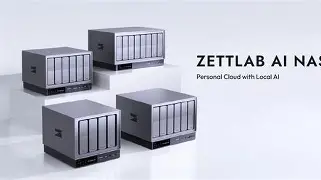
Finally, regarding storage—don't skimp on the drives. The D6 is high-performance, and putting slow, consumer-grade green drives in it is like putting budget tires on a Ferrari. I’ve found the best results using Enterprise-capacity drives (18TB+) as they tend to handle the vibrations of a 4-bay enclosure better over the long term. If noise is a primary concern because the device will sit on your desk, look into the specific acoustics of the drives you choose, as the aluminum chassis of the D6 does tend to resonate a bit more with "clunky" drives than a plastic-heavy enclosure might.
Final Thoughts After Eighteen Months
Reflecting on my time with the Zettlab D6, I’m struck by how much my expectations for a NAS have changed. I used to think of a NAS as just a box that held my files. Now, it’s my personal media server, my backup vault, my home automation hub, and my high-speed workspace. The D6 hasn't just survived the last two years; it has become more capable as the software has matured. It’s rare to find a piece of tech that actually feels "better" two years after you bought it, but thanks to the aggressive software update cycle from Zettlab, that is exactly the case here.
I was disappointed by the fan longevity and the plastic tabs on the drive trays, but these are minor gripes in the grand scheme of things. The core mission of the device—keeping my data safe and accessible at high speeds—has been a resounding success. I’ve moved hundreds of terabytes through this machine, and it has never once let me down during a critical deadline. In an era where "planned obsolescence" is the norm, the Zettlab D6 feels like a bit of an outlier. It’s a robust, over-engineered piece of hardware that was designed to be relevant for five to seven years, not just one or two.
If you find yourself needing a storage solution that can handle 4K (or even 8K) editing, a massive media library, and a dozen background services, the D6 is still an easy recommendation in 2026. It has enough power to stay relevant for several more years, and the stability of the current OS version makes it a joy to use on a daily basis. My desk has seen many gadgets come and go, but the Zettlab D6 has earned its permanent residency.